








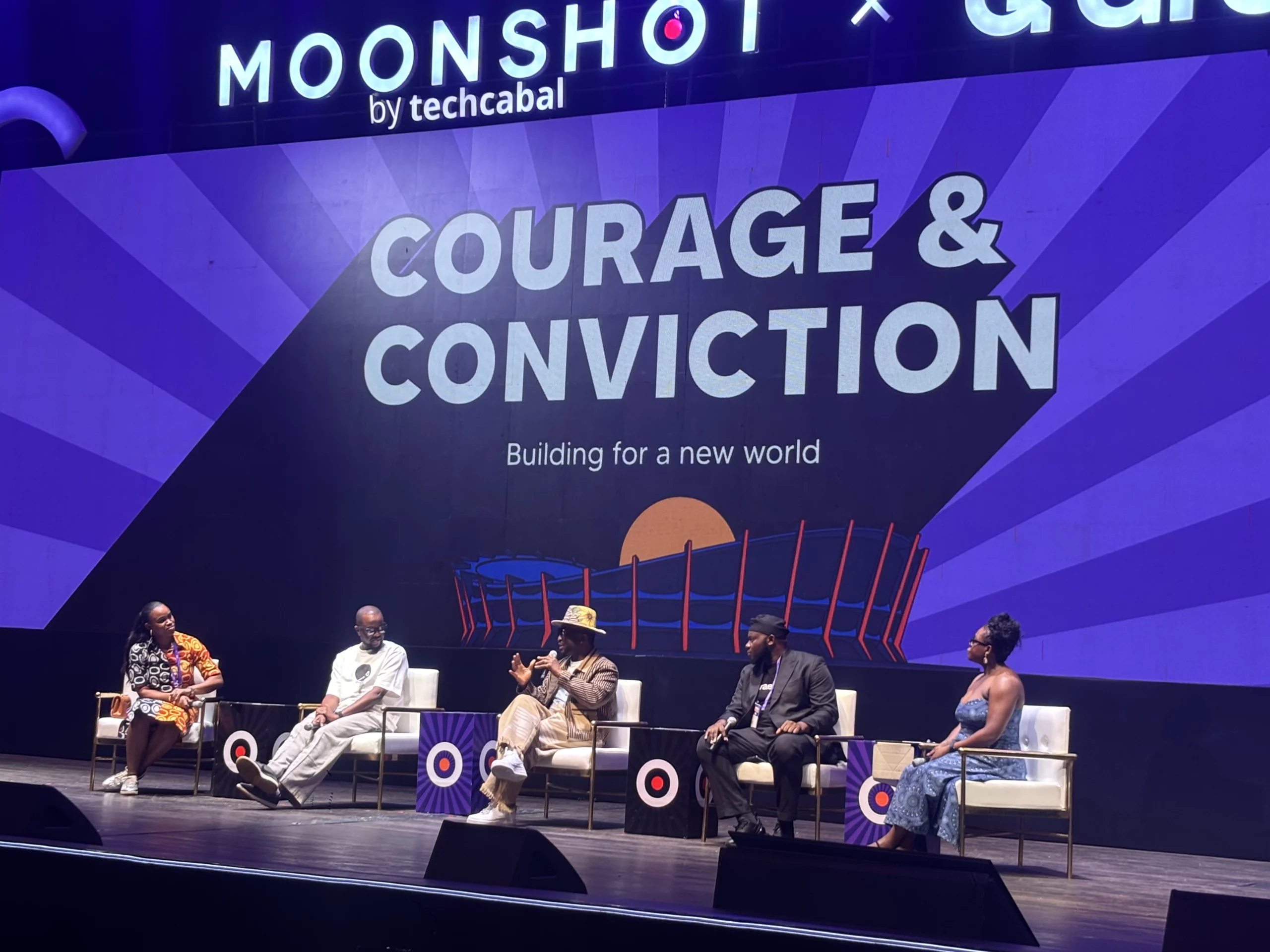
The growth of Africa’s creative economy depends on the infrastructure supporting its talent, businesses and creative output. From technical production capabilities to investment, industry partnerships and access to larger markets, closing these gaps will determine how effectively the continent’s creative industries can scale. This was the central argument advanced by Livespot Co-founder Darey Art Alade at Moonshot by TechCabal 2026.
Held at the National Theatre, Lagos, on October 28 and 29, Moonshot brought together entrepreneurs, investors, technology leaders and creative industry stakeholders for conversations about building sustainable businesses and shaping Africa’s economic future.
Darey joined Richard Oyome, Co-founder and COO of Raenest; Kene Okwuosa, Founder and Group CEO of Filmhouse Group; and Kopano Cowen, CEO of Connect Channel, on a panel titled Can African Players Build the Infrastructure Creators Need? The session, moderated by Kehinde Odusote-Fagbule of TechCabal Insights, examined the infrastructure challenges affecting creators and the businesses working to support Africa’s growing creative economy.
Drawing from his experience as an artist, entrepreneur and entertainment industry executive, Darey traced Livespot’s evolution to the practical challenges of bringing creative ideas to life.
He recalled an early period when he envisioned creating large-scale entertainment experiences but encountered significant limitations in the resources, expertise and infrastructure available to execute them.
“We spent a significant amount of time consulting, engaging vendors, and talking to different partners across the industry just to get the project off the ground. Managing a show of that magnitude teaches you exactly where the infrastructure gaps are, and navigating those challenges is what gave birth, essentially, to Livespot.”
What began with the ambition to deliver distinctive live experiences developed into a business that increasingly recognised opportunities to strengthen different parts of the creative value chain. Through its work across entertainment, experiential production and large-scale events, Livespot has continued to invest in the capabilities required to deliver complex productions and develop platforms that create opportunities for the wider industry.
Projects such as Born in Africa Festival, Entertainment Week Africa and Detty December Fest demonstrate this approach. Beyond the experiences themselves, these platforms require considerable coordination, technical expertise, production infrastructure and collaboration across multiple disciplines.
Darey explained that building these capabilities has required deliberate investment, persistence and a willingness to develop solutions where gaps exist. He acknowledged the financial realities of operating in the entertainment industry, including the continuous effort required to secure sponsorship and funding for ambitious projects.
“We’ve been able to use that to build. And we’re still building,” he said. “Because it’s all about closing the gap for us at Livespot.”
Building capacity across the creative value chain
An important part of the discussion centred on vertical integration and the balance between strengthening a business through additional capabilities and spreading its resources too thinly.
Responding to a question about when businesses should build additional layers of the value chain, Darey’s contribution pointed to the importance of making deliberate decisions based on operational needs and the gaps that directly affect delivery.
While partnerships remain important to developing the creative ecosystem, businesses also need to recognise where greater control, investment, and internal capacity are necessary to deliver consistently.
The conversation also explored the role of private-sector participation and international partnerships in developing commercially sustainable infrastructure.
Darey highlighted the contribution of private businesses through capital, expertise, operations, and programming, alongside the opportunities that cross-border partnerships create for attracting investment, developing technical skills, and transferring knowledge.
He argued that strengthening these relationships could support the development of larger physical infrastructure and expand the capacity of the industry as a whole.
The objective, as he explained, is to create infrastructure that can operate commercially while supporting increased activity across the creative value chain.
Activating Africa’s creative market
Darey also challenged the recurring perception that Africa’s creative economy is constrained by a small market.
Acknowledging the infrastructure deficits affecting the industry, he questioned whether the market itself was inherently small or whether its full commercial potential remained untapped.
“I get why it feels like it’s a small market, but it feels like it’s a small market because we haven’t been able to activate the market size,” he said.
His argument draws attention to the relationship between infrastructure and market development. When businesses have access to stronger production capabilities, larger platforms, investment, and effective industry partnerships, they are better positioned to expand their reach, create commercial opportunities, and serve audiences at a greater scale.
This thinking continues to inform our investment in experiences and platforms that connect entertainment, business, technology, and culture, and build the systems and capabilities that allow African creativity to translate into sustainable businesses and a stronger global presence.